
Where to get official air-raid alerts on the EU's eastern flank
Official air-alert channels by country: Poland, Estonia, Latvia, Lithuania, Romania, Finland and Moldova, in the officials' own words.
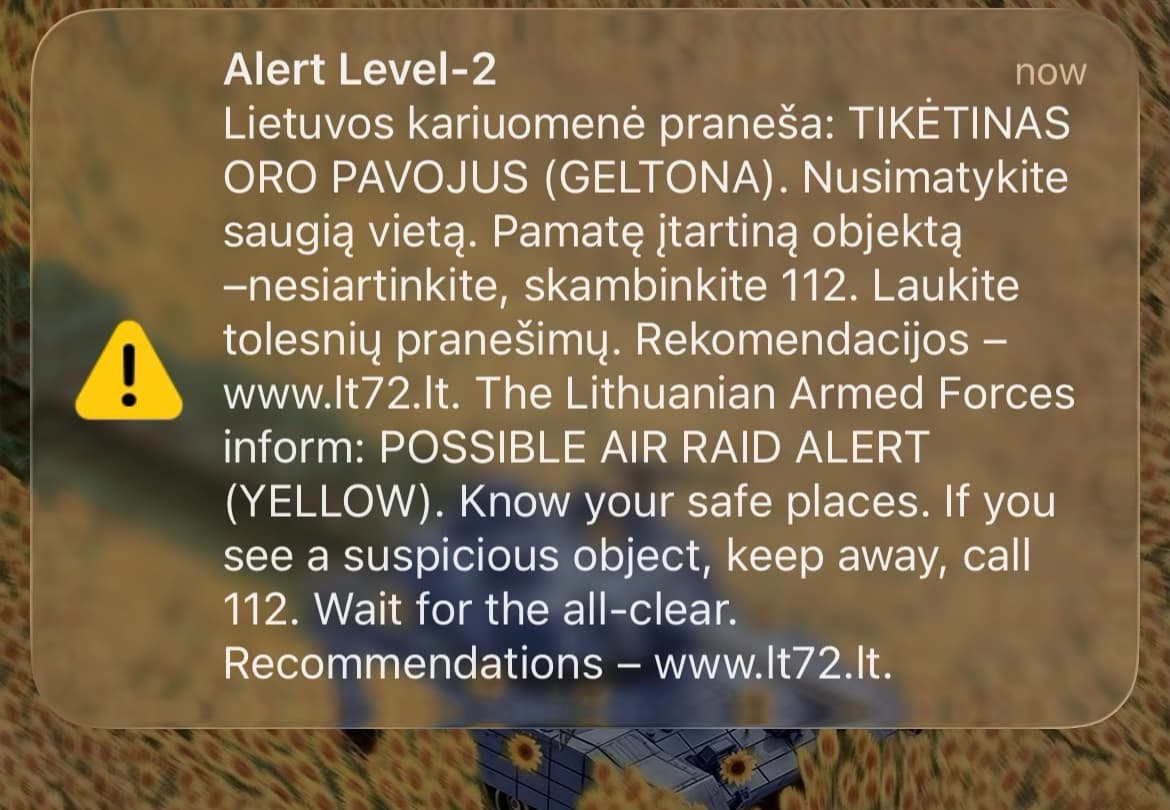
In an emergency, people should follow one authoritative source. In AirVeto's view, a second, unofficial source that may disagree costs time that people in an emergency do not have. AirVeto therefore does not issue or relay live alerts, and this page points to each country's official channel instead.
AirVeto is a record. It reconstructs airspace events after they happen, with sources and wind. This page sets out how each country on the eastern flank says residents receive its official air-threat alerts, in the words of the bodies that run them. Poland, Estonia, Latvia and Lithuania say the alert reaches phones directly, and Romania runs RO-ALERT. Finland relies on an app, radio and television until its phone system goes live. Moldova's government says it has no such mechanism yet.
AirVeto adds no instructions of its own. Every instruction below is quoted or translated from the cited official source.
Poland: an Alert RCB message reaches every phone in the area, with nothing to install
Poland's Government Security Centre (Rządowe Centrum Bezpieczeństwa, RCB) runs Alert RCB. Its FAQ says: "Na alert RCB nie trzeba się zapisywać. Osoby, które znajdą się na obszarze potencjalnego zagrożenia, otrzymają na swój telefon komórkowy SMS z ostrzeżeniem." In translation: "There is no need to sign up for the RCB alert. People in the area of potential danger will receive a warning SMS on their mobile phone." On apps, the FAQ answers: "Żeby go otrzymywać, nie trzeba instalować żadnej aplikacji czy programu" ("To receive it, you do not need to install any app or program") (RCB FAQ).
The FAQ states that "Najmniejszym obszarem, na który może być wysyłany Alert RCB, jest powiat" ("The smallest area an RCB Alert can be sent to is a powiat", a county). RCB also publishes each alert on its own site. The page for October 21, 2026 carries the text sent to recipients in Lubelskie and Podkarpackie voivodeships: "Rosyjski atak powietrzny na terenie Ukrainy. Sytuacja jest monitorowana. W przestrzeni RP operuje polskie lotnictwo. Oczekuj dalszych komunikatów." In translation: "Russian air raid on Ukrainian territory. The situation is being monitored. Polish aircraft are operating in Polish airspace. Expect further communications." The message opens with the word "UWAGA" ("attention"). The all-clear reads: "Zakończył się atak powietrzny na Ukrainę. Brak zagrożenia na terenie Polski" ("The air raid on Ukraine has ended. No threat on Polish territory") (RCB, 21 October).
On what to do, RCB's FAQ gives one line: "Należy zastosować się do treści zawartych w wiadomości SMS" ("One should follow the contents of the SMS message").
Estonia: EE-ALARM by SMS, in the Ole valmis and Eesti.ee apps, and on ETV
Estonia's Rescue Board (Päästeamet) describes the system on kriis.ee. The sender of the SMS is EE-ALARM, and a person without an Estonian number receives it from +372 5950 0000. In the page's words: "Sõnumi saatjaks on EE-ALARM. Juhul, kui inimesel ei ole Eesti numbrit, saabub sõnum numbrilt +372 5950 0000." The channels it lists: the SMS to people in the danger area, the mobile apps "Ole valmis" and "Eesti.ee", a banner on ETV and ETV+ and on the ERR portal, and where needed loudspeakers, door-to-door visits and drones (kriis.ee).
The page says a message always opens with the sending authority's name and that "Igas ohuolukorras saadetakse vähemalt kaks sõnumit: esimene ohu alguse ja teine ohu lõppemise kohta". In translation: "In every danger situation at least two messages are sent: the first on the start of the danger and the second on its end." To check that a message is genuine and not spam, the page says: "Teavituse õigsust saab esmalt valideerida kriis.ee veebilehelt" ("The correctness of the alert can first be validated on the kriis.ee website"). Since October 14, 2026, kriis.ee collects the alerts sent in an archive view.
For the sirens, kriis.ee says they are installed in 22 settlements and sound "ainult äärmuslikul juhul" ("only in an extreme case").
Latvia: cell broadcast from the State Fire and Rescue Service, since July 1, 2025
Latvia's State Fire and Rescue Service (VUGD) decides on alerts and sends them by cell broadcast, which began operating on July 1, 2025. Public broadcaster LSM, citing the LETA newswire, reported that the system needs no registration or subscription, is free, and that cell broadcast messages "are not SMS messages": they appear in a special format with a distinctive sound. It reported the Interior Minister Rihards Kozlovskis and VUGD chief Colonel Mārtiņš Baltmanis on the system. Red and orange alerts go out as a cell broadcast with sound, the others as SMS; messages are in Latvian, in some cases with English (LSM).
The same report notes that VUGD also has an app called "112". VUGD's Ilze Dāme said, as LSM quoted: "Apdraudētajā zonā cilvēks par apdraudējumu saņem šūnu apraides paziņojumu. 112.lv lapā šis apdraudējums un informācija, kas iekļauta šūnu apraides paziņojumā, tiek dublēta." In translation: "In the endangered area, a person receives a cell broadcast message about the danger. On the 112.lv page this danger and the information in the cell broadcast message are duplicated." LSM also reported that the 112.lv site briefly became unavailable under visitor load during an earlier alert (LSM, May 23, 2026).
VUGD's own site (vugd.gov.lv) did not respond to AirVeto's fetch, so the Latvian entry rests on LSM and LETA quoting the officials.
Lithuania: alert messages to phones and the LT72 app, in three levels
Lithuania's Fire and Rescue Department (PAGD) and the Ministry of National Defence set out the levels in an explainer that LRT summarised on May 20, 2026. A yellow "probable air danger" alert means no potentially dangerous object is in Lithuanian territory but a threat is possible. A red air alert means "an unidentified object is flying in Lithuanian airspace or there is a high probability that it will enter". An all-clear is white. LRT reports that "residents receive a separate message for each type of alert, including for the all clear announcement", and that recommendations and a map of shelters are on the government's emergency response website, LT72.lt (LRT).
On how the message arrives, PAGD said before a nationwide test on April 30, 2026 that people would get alert messages on their mobile phones and notifications via the LT72 app. LRT quoted the department: "Alert messages are sent to all mobile users, but they are received only on devices with the alert function enabled. Instructions on how to activate the service are available on the LT72 website and in the mobile app." The department also said that on hearing sirens or receiving an alert message, people should turn on LRT RADIO or LRT TV for official information (LRT).
The sites of LT72 (lt72.lt), the Defence Ministry (kam.lt) and the Fire and Rescue Department could not be fetched by AirVeto (Cloudflare challenge), so the Lithuanian entry rests on LRT quoting those bodies.
Romania: RO-ALERT, run by the Ministry of Internal Affairs through the emergency department
Romania's Ministry of Internal Affairs (MAI) publishes the statements of Raed Arafat, head of the Department for Emergency Situations (DSU). On March 4, 2026 he described RO-ALERT as "un sistem prin care puteți să transmiteți mesaje fiecărui cetățean", in translation "a system through which messages can be sent to every citizen". He said Romania implemented it in 2018, and that on phones which have not been updated, "orice alertă care se dă, va suna cu sunetul vechi" ("any alert issued will sound with the old sound"). His advice, in translation: not to listen to those who advise switching the system off, and to update the phone software (MAI).
For air threats, the order of events is on record. After the Galați strike of May 29, 2026, Interior Minister Cătălin Predoiu said the General Staff issued two air alarms, at 1:48 for Tulcea and 1:50 for Galați and Brăila, and that "după emiterea acestor alarme de către Statul Major al Forțelor Armate a fost emis semnalul Ro-Alert la două minute pentru Tulcea, două minute pentru Galați". In translation: "after these alarms were issued by the General Staff of the Armed Forces, the Ro-Alert signal was issued two minutes later for Tulcea, two minutes later for Galați" (MAI).
The RO-ALERT portal (ro-alert.ro) did not respond to AirVeto's fetch, so no address is given here.
Finland: the 112 Suomi app, radio, television, and FI-Alert due by the end of October 2026
The Finnish Government states that emergency warnings are currently published "in the 112 Suomi app, on the radio, on teletext page 112 and, if needed, on television", with other channels including the Yle app and the 112.fi, pelastustoimi.fi and yle.fi websites. A new cell-broadcast system, FI-Alert, is to be built "by the end of October 2026" and "will complement the current emergency warning system, rather than replace it". The release adds that it "will not require the installation of a separate application" (Finnish Government).
For the drone alert of May 15, 2026, the Interior Ministry issued an emergency warning for Uusimaa shortly before 4:00 and an all-clear at about 7:00. The Government said that "At a minimum, emergency warnings are sent through the 112 Suomi app, broadcast on the radio and, if necessary, shown on television", and that a feature to warn of airborne threats will be added to the 112 Suomi app (Finnish Government). The Emergency Response Centre Agency's 112.fi front page carries the line "Tee turvallisuusteko ja lataa 112 Suomi -sovellus" ("Do a safety deed and download the 112 Suomi app") (112.fi).
AirVeto did not confirm that FI-Alert had gone live by October 22, 2026.
Moldova: the government says there is no public-warning mechanism yet
Moldova's government approved the concept of MD-ALERT, a public-warning system working through mobile networks. The press release says: "În prezent, țara noastră nu dispune de un mecanism eficient de avertizare publică, capabil să transmită în timp real mesaje către populație". In translation: "At present our country does not have an effective public warning mechanism capable of transmitting real-time messages to the population." MD-ALERT "va fi operațional în anul 2027" ("will be operational in 2027") and will not require installing additional applications (Government of Moldova).
AirVeto found no official live air-alert channel in Moldova to point to. The official number for reports there is 112, as set out in Where to report drone wreckage. This section will change when MD-ALERT launches.
Side by side: four phone-based alerts, RO-ALERT, one app-led system, one gap
| Country | Official body | How the alert arrives | Source of the wording |
|---|---|---|---|
| Poland | RCB | Alert RCB message to phones in the area; no sign-up, no app | RCB FAQ |
| Estonia | Päästeamet | EE-ALARM SMS (+372 5950 0000 for foreign numbers), Ole valmis and Eesti.ee apps, ETV banner | kriis.ee |
| Latvia | VUGD | Cell broadcast; 112.lv and the 112 app duplicate it | LSM/LETA quoting officials |
| Lithuania | PAGD, Ministry of National Defence | Alert messages to phones with the function enabled; LT72 app; LRT radio and TV | LRT quoting officials |
| Romania | MAI / DSU | RO-ALERT; on May 29, 2026 it followed the General Staff's air alarms by two minutes | MAI |
| Finland | Interior Ministry | 112 Suomi app, radio, teletext 112, television; FI-Alert due by end of October 2026 | Finnish Government |
| Moldova | Government | None yet; MD-ALERT planned for 2027 | gov.md |
AirVeto's record of past alerts, by country
These pages are records of alerts that have already ended. Each reconstructs the event from the cited sources and the wind of the day. They are not live and carry no warnings.
- Lithuania: Vilnius yellow air alert, October 3, 2026, where the three sources give three cancellation times, and the Pasvalys drone after a red air alert, October 18, 2026.
- Estonia: the seven-county EE-ALARM alert of March 31, 2026.
- Latvia: the five-county shelter alert in eastern Latvia.
- Poland: the Malbork air alert, September 22, 2026.
- Romania: the Tulcea alert of July 7, 2026 and the Galați strike of May 29, 2026.
- Finland: the Kotka drone alerts, July 2026.
For the wind behind a past alert, open the live map.
Sources
- RCB - Alert RCB - Najważniejsze Pytania i Odpowiedzi (retrieved 22 Oct 2026)
- RCB - Alert RCB - zagrożenie z powietrza (21 Oct 2026)
- kriis.ee - Ohuteavitus ehk EE-ALARM (retrieved 22 Oct 2026)
- LSM - Cell broadcasting system starts working in Latvia (2 Jul 2025)
- LSM - Šūnapraides brīdinājumu problēmu dēļ secina: 112.lv lietotnes uzlabošanai vajag vēl 600 000 eiro (23 May 2026)
- LRT - Understanding air alert warnings in Lithuania - explainer (20 May 2026)
- LRT - Lithuania is testing public alert system on Thursday (30 Apr 2026)
- MAI - Antena 1: Cum se modifică sistemul RO-Alert (4 Mar 2026)
- MAI - Cătălin Predoiu: declarații de presă din județul Galați (29 May 2026)
- Finnish Government - Finland to introduce new emergency warning system this year (Jun 2026)
- Finnish Government - Authorities worked together effectively to counter drone threat (15 May 2026)
- Emergency Response Centre Agency - 112.fi (retrieved 22 Oct 2026)
- Government of Moldova - MD-ALERT: Republica Moldova va avea un sistem național de avertizare pentru situații de urgență (2026)