

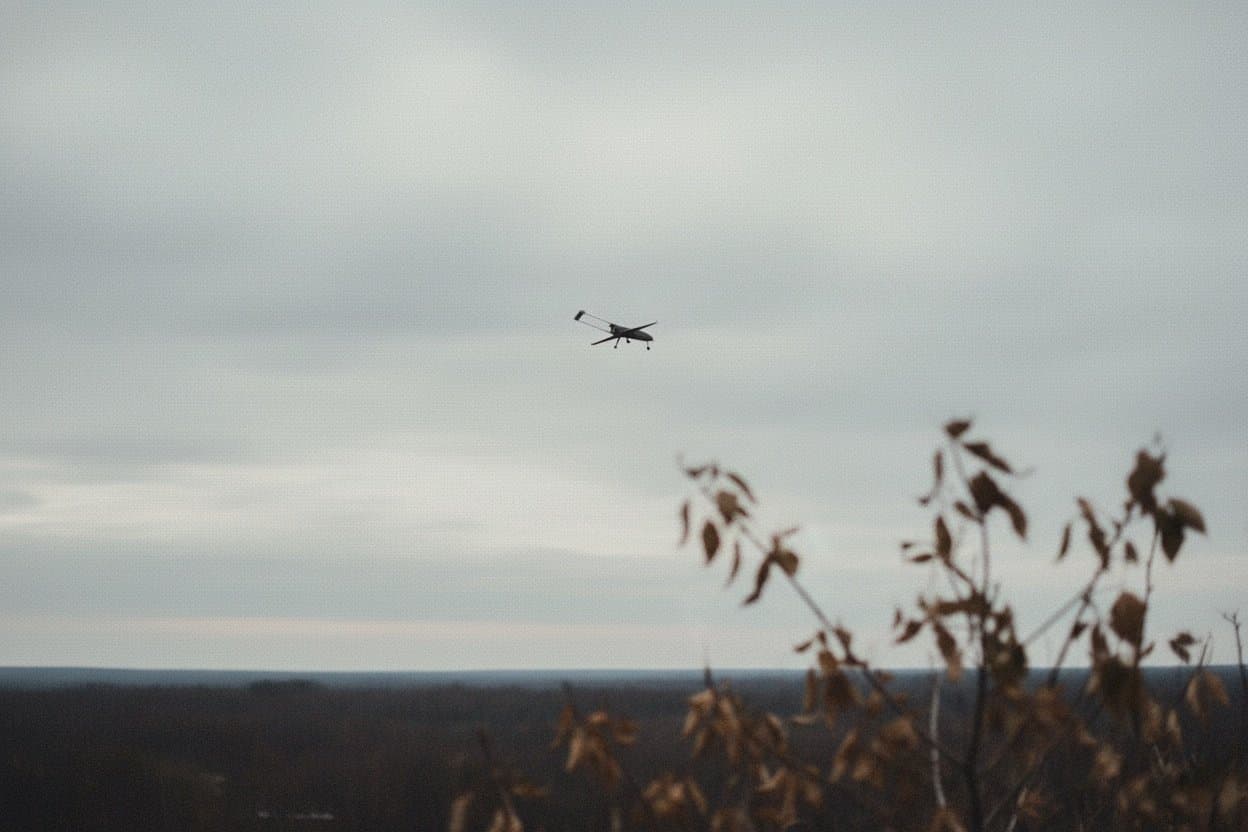
The drone that came down near Osiny in eastern Poland on the night of 19–20 August 2025 was an Iranian design built in Russia. Ukrainian defence analysts assessed it as a Shahed-136 that had flown roughly 100 kilometres into Polish airspace, according to Defense Express; Polish officials disputed the type while confirming a drone had crossed. AirVeto reconstructed the wind field over that incursion as part of our running record of the drones that reach the EU's eastern border. Every one of them traces to a supply relationship between two allies.
Iran designed the airframe. Russia builds it. The object that keeps landing on NATO soil is the output of a two-country production line, and the wreckage in a Polish field is the far end of it.
The Shahed-136 is an Iranian design that Russia builds under its own name
The Shahed-136 is a loitering munition developed by Iran's HESA under the Shahed Aviation Industries design bureau, first shown operationally in 2021. It is a cropped delta-wing airframe roughly 3.5 metres long, driven by a piston engine to a cruise speed near 185 km/h, carrying a warhead most often cited at 30 to 50 kilograms. Iran first used the type in 2019 against Saudi oil facilities at Abqaiq and Khurais.
Russia produces its own copy at the Alabuga Special Economic Zone in Tatarstan under the name Geran-2. That version, not the Iranian original, is the one now most often recovered over Ukraine and, on the nights it strays, over EU territory. When Polish or Lithuanian wreckage is identified as a Shahed, it is almost always a Russian-built Geran-2.
Russia bought the capability to build the drone, not just the drones
The transfer began after Russia's full-scale war on Ukraine started in 2022, and it went well beyond selling finished airframes. In early 2023, the Alabuga zone agreed to buy the Shahed-136 manufacturing capability itself. Leaked Alabuga contract documents, reported by CNN and others, valued the franchise deal at roughly 1.75 billion dollars: about 600 disassembled drones, the tooling, the training, and enough Iranian-supplied components to build around 1,350 more.
The contract set a target near 6,000 drones, and Russia hit it. Ukraine's Defence Intelligence estimates Alabuga now produces more than 5,500 units a month, and analysts cited by CNN assess that roughly 90 percent of production stages have moved onto Russian soil. That localisation has strained the alliance it grew from: reporting through 2025 describes Moscow marginalising Tehran as Russian industry absorbed the design.
The drones sit inside a wider war economy on both sides. Ukraine answers the campaign by striking the Russian oil infrastructure that funds it: the refinery strikes that produced a domestic fuel crisis and the long-range strikes on Moscow. The Shahed line at Alabuga is one node in that economy; the wreckage on the Polish border is another.
The alliance transfers components and documentation, not just airframes
The Shahed is a globalised object, and what crosses into Polish airspace is an Iranian blueprint assembled in Russia from parts sourced worldwide. When Conflict Armament Research examined the remains of two Geran-2s recovered in Ukraine in July 2023, it identified them as a new, Russian-manufactured variant of the Iranian design rather than imported Iranian units, with a redesigned airframe and altered internals.
Those internals are mostly foreign. Teardown analyses of downed Geran-2s found them dominated by Western-manufactured electronics, most of them American, despite the sanctions meant to block that supply. In December 2023, Ukraine's National Agency on Corruption Prevention catalogued 55 US-made parts in a single drone, alongside 15 from China, 13 from Switzerland, and 6 from Japan. The engine and warhead began as Iranian supply before the Alabuga contract shifted responsibility for those internals onto Russia for the bulk of the run.
The same airframes reach Polish and Baltic airspace
Three Polish cases show the line's output landing on NATO soil. The Osiny drone in August 2025 was assessed as a Shahed-136 that had flown deep into Poland. Weeks later, a Gerbera decoy came down in a field near Majdan-Sielec, about 50 kilometres from the Ukrainian border. A further drone, presumed but not confirmed to be a Gerbera, was found in March 2026 in a mine near Gałczyce and is thought to date from the same September 2025 wave.
The Gerbera matters because it is built to be mistaken for the Shahed. It is a Russian fixed-wing decoy of foam and plywood, roughly a fifth the cost of a Shahed, designed to mimic the Geran-2 on radar and draw air-defence fire away from the armed drones flying the same route. Russia launches the two together in mixed raids, which is why wreckage identification along the Polish–Belarusian border and across NATO's eastern flank is so often contested at first.
Why the cheap decoys drift and the strike drones hold their course
This is where the reconstruction earns its place. The Shahed-136 is a heavy airframe on inertial and satellite guidance; it holds a programmed course, and wind is a minor correction on its track. The Gerbera is light, low, and cheaply built, which makes it one of the more wind-affected types we follow along the Polish border. Where it ends up owes as much to the airflow that day as to where it was aimed.
That distinction is the analytical line our methodology draws on every drone page: for a powered strike drone, wind is context, not trajectory; for a foam decoy at low altitude, drift can move the crash site by kilometres. When a Gerbera turns up in a field far from any plausible target, the wind reconstruction is often the only tool that explains how it got there.
The wreckage pattern is the supply chain, read backwards
The objects reaching NATO airspace are not a series of unrelated crashes. They are the tail end of a production line that Iran designed, Russia bought, and Russian industry now largely runs on its own. They go up in mixed raids of strike drones and decoys, wired with globally sourced parts, and identified only after they land. The recurring disputes over type, from Osiny's contested Shahed to the presumed Gerbera at Gałczyce, are what attribution looks like when the airframe is deliberately ambiguous.
For AirVeto, each of these is a wind problem before it is anything else. See where the airflow is carrying things across the eastern border right now on the live map.